

Qeparo is one of those places on the Albanian Riviera that makes more sense when you give it an entire day.
At sea level, you have clear Ionian water, a long waterfront and somewhere to settle in for a slow morning. Look towards the mountains, however, and another Qeparo is waiting above you.
Old Qeparo, the historic stone village on the hillside, feels remarkably different from the coastal settlement below.
The two together are what make Qeparo interesting.
You could stop at the beach for an hour while travelling between Himarë and Sarandë, but you would miss half the destination. Albania’s official tourism site describes Qeparo specifically as a place where the beach and old village form two distinct parts of the same experience.
So instead of treating Qeparo as another beach stop, spend a day going from the Ionian Sea to the old stone lanes above it.
Here is how.
Morning: Start at Qeparo Beach
Start where most people first encounter Qeparo: beside the sea.
Located south of Himarë on the Albanian Riviera, Qeparo Beach offers the blue water and mountain backdrop that travellers come to this part of Albania to find. Albania’s tourism authority describes it as a relatively peaceful coastal destination, particularly compared with some of the Riviera’s busier summer centres.
During July and August, nowhere along the popular Riviera is completely quiet, but Qeparo generally has a different feel from destinations dominated by beach clubs.
The best plan is simple.
Arrive in the morning, find somewhere along the waterfront and go swimming before the strongest heat of the day.
The coastline here gives you enough space to spend a few hours without needing an activity every twenty minutes. If you are travelling as a couple, with friends or as a family, it is an easy place to slow your itinerary down.
Take a walk along the waterfront after your swim. Stop for coffee. If you are staying in Qeparo itself, this is also a good opportunity to leave the car behind for a while.
But don’t settle in for the entire day.
The mountains behind you are where Qeparo becomes much more interesting.
Lunch by the Sea Before Heading Uphill
Before travelling to Old Qeparo, have lunch near the coast.
The obvious choice in this part of Albania is to keep things local and Mediterranean: grilled fish, seafood, salads, vegetables, cheese and simple meat dishes are commonly found throughout the Riviera.
There is one practical reason for eating before going uphill too.
The lower part of Qeparo has considerably more tourist infrastructure, accommodation and places catering to summer visitors. Official tourism information notes that much of the area’s accommodation is concentrated around Lower Qeparo and near the beach.
Old Qeparo is better approached as somewhere to explore rather than somewhere where you expect a large choice of services.
After lunch, take some water with you, change out of your beach shoes if necessary, and start climbing.
Afternoon: Drive Up to Old Qeparo
From the coast, the road turns inland and climbs towards Old Qeparo, also known as Upper Qeparo.
The distance on a map does not seem dramatic, but the change in atmosphere is.
The modern coastal settlement gradually falls away behind you. Olive trees cover sections of the hillside, the sea becomes a view rather than somewhere you can immediately step into, and old stone buildings begin to appear.
Eventually, you reach a village that looks very different from the Qeparo you left below.
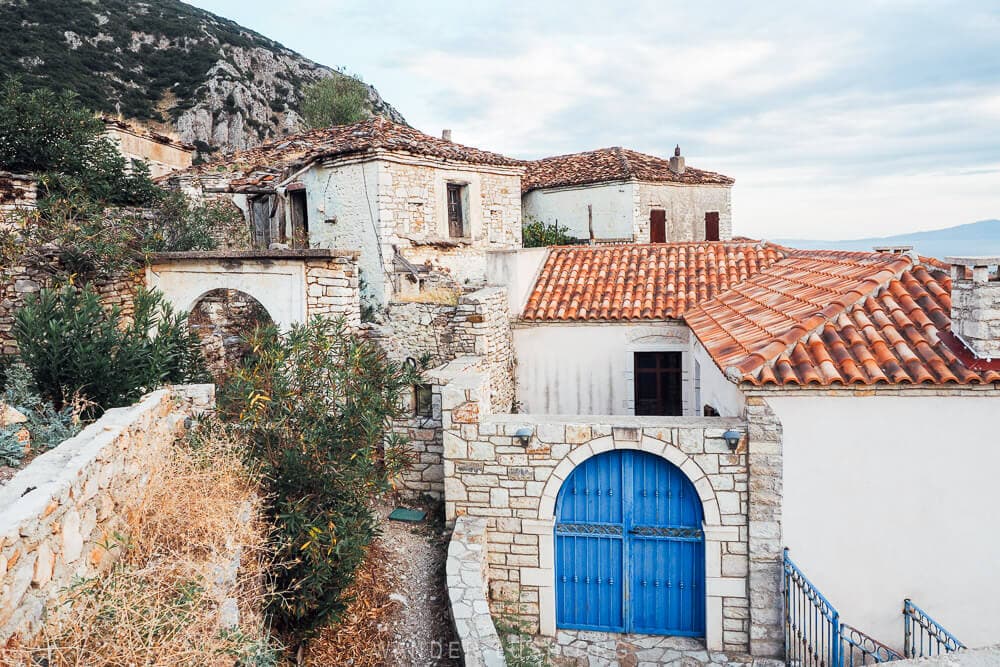
Traditional stone houses stand along narrow lanes. Some buildings have been maintained or restored, while others clearly show their age. Small passages lead between homes, walls and terraces.
This is not a reconstructed “old town” created specifically for tourists. Old Qeparo is the historic part of the settlement itself.
The Albanian National Tourism Agency identifies its stone houses, narrow alleys and elevated coastal views as the main reasons to visit.
And there is no complicated sightseeing plan required once you arrive.
Park where appropriate and walk.
What to See in Old Qeparo
The best way to experience the village is by following its lanes rather than trying to find a checklist of attractions.
The official Southern Coastal Trail passes through Old Qeparo and specifically recommends exploring the village’s small alleys and central square, where a large plane tree stands. The same route highlights viewpoints over both the old settlement and the modern coastal village below.
Allow yourself to wander.
Look at how the houses were built into the slope. Notice the stonework, gateways and small courtyards. Every few minutes, an opening between the buildings reveals the Ionian Sea far below.
Qeparo’s location is what gives the village much of its character. You are close enough to the coast to see it clearly, but high enough to understand why the old settlement and today’s beach resort feel like separate places.
Find the viewpoints
Do not leave Old Qeparo without stopping somewhere overlooking the coast.
From the hillside, the geography of the area becomes much easier to understand.
Below is Lower Qeparo and its shoreline. Further along the coast are Borsh in one direction and Porto Palermo and Himarë in the other.
The official tourism authority notes that Qeparo is well positioned for visiting all three, making it a useful stop on a wider Albanian Riviera road trip.
It is also one of those views that explains why travelling inland for even a few kilometres makes such a difference in southern Albania.
From the beach, you see mountains.
From the village, you see the entire coast.
The History Is Older Than the Beach Resorts
Qeparo is not interesting only because its stone houses photograph well.
The area has a much longer history.
Above Old Qeparo stands Karos Castle, an archaeological site located on a rocky hill approximately 450 metres above sea level. Himarë Municipality describes the site as an ancient fortified settlement with several lines of defensive walls and links it with the prehistoric settlements of the wider Chaonia region.
You do not necessarily need to turn your relaxed day in Qeparo into an archaeological expedition, but knowing these sites exist changes how you see the village.
The settlements above the modern Riviera were here long before tourism moved activity towards the shoreline.
The wider Qeparo area also includes historical religious buildings. The Monastery Church of Saint Theodore, located above Old Qeparo, is a protected cultural monument featuring Orthodox architectural elements and surviving frescoes.
Travellers particularly interested in architecture and history may therefore want to leave more time for the upper part of Qeparo rather than treating it as a quick viewpoint.
Why Are There Two Qeparos?
Qeparo’s unusual layout tells part of the story of the Albanian Riviera.
Historic settlements along this coastline were often established higher on the mountain slopes rather than directly beside today’s beaches. Modern development later expanded closer to the sea and the main coastal road.
Today, that leaves visitors with two very different experiences under the same name.
Lower Qeparo is where you go for:
- Swimming
- Beach time
- Waterfront walks
- Restaurants and cafés
- Most tourist accommodation
Old Qeparo is where you go for:
- Traditional stone architecture
- Historic lanes
- Coastal viewpoints
- Churches and cultural heritage
- A quieter look at the Riviera’s past
You do not need to choose between them.
The point of spending a full day here is to experience both.
Can You Explore Qeparo Without a Car?
Lower Qeparo is situated directly along the main Riviera corridor, but having a car makes exploring Old Qeparo and the surrounding region much easier.
It also gives you the flexibility to combine Qeparo with Porto Palermo, Borsh and smaller stops without planning your day around transport schedules.
If Qeparo is part of a larger Albania road trip, you can compare car rental options with Albaways, one of our partners.
Keep in mind that roads leading into older mountain villages can be narrow and steep. Take your time and park responsibly rather than trying to drive deep into every lane.
When Is the Best Time to Visit Qeparo?
For swimming, the warmer months are the obvious choice.
July and August bring the hottest weather and busiest period along the Albanian Riviera. If you prefer fewer visitors while still wanting a coastal holiday, June and September are worth considering.
For exploring Old Qeparo itself, spring and early autumn can also be excellent because walking around the village is more comfortable outside the strongest summer heat.
Whatever month you choose, the basic plan remains the same:
Beach first. Village later.
It works particularly well because you avoid spending the hottest part of the afternoon climbing through stone lanes while still getting plenty of time beside the sea.
Qeparo Is More Than a Beach Stop
Qeparo represents something that is easy to miss when travelling quickly along the Albanian Riviera.
The coastline may attract you here, but it does not tell the entire story.
Spend the morning swimming in the Ionian. Have lunch near the shore. Then leave the beach behind and follow the road into the hills.
By the time you reach Old Qeparo, the sunbeds, cafés and waterfront are far below you. In their place are old stone houses, narrow streets, olive-covered hills and views stretching across the coast.
You have not travelled very far.
But you have seen two completely different sides of southern Albania in a single day.
And that is exactly why Qeparo deserves more than a quick swim before you continue down the Riviera.